Half-Frame, Full-Frame: What Changes When the Negative Shrinks
Half-frame uses a smaller image area than standard 35mm, which affects framing, enlargement and the rhythm of a roll. Here’s how to decide which format suits the pictures you want to make.

You load a roll of 35mm film, point a compact camera at a friend across a café table, and wonder whether the frame will feel roomy or cramped. A full-frame 35mm camera exposes a larger area for each picture; a half-frame camera exposes a smaller one, often allowing two images in the space used for one full-frame exposure. That difference changes composition, enlargement and the rhythm of a roll, but it does not make one format right for every subject.
Frame size
Half-frame uses the same width of 35mm film as a standard full-frame camera, but the camera’s gate—the opening that defines the exposed picture—is smaller. “Half” refers to the image area, not to a different kind of film. The exact dimensions and orientation depend on the camera, so consult its manual when precise framing or cropping matters.
The smaller negative gives you less image area to enlarge or crop. When two negatives are enlarged to the same print size, the half-frame image requires more enlargement, so grain and fine detail may become more visible. The effect depends on the film, lens, focus, exposure, scanning or printing method, and intended viewing size.
For a small print, a phone screen or a picture built around bold shapes, the difference may be subtle. Fine textures and distant lettering are less forgiving if you want a large print. A well-made half-frame negative can still produce an appealing image; it simply leaves less room for enlargement before the negative’s texture becomes prominent.
Frame shape
Half-frame cameras commonly produce portrait-oriented images, while many standard 35mm cameras make landscape-oriented ones. The shape nudges your choices without dictating them. A standing person, doorway or lamppost can sit naturally in a vertical frame. A broad shoreline or a group at a long table may feel more at home in a horizontal one.
Look at the edges before pressing the shutter. In a vertical picture, a cluttered foreground can take up a large share of the image; stepping closer or shifting your position may give the subject more room. A wider frame can include context at either side, though that extra space can also admit distractions.
Say you are photographing a friend beside a painted café door. In this invented situation, the door’s vertical panels and your friend’s upright posture are the starting details. You frame them together with a half-frame camera; the expected result is a portrait-oriented image that links the person and the door. If you instead want the table, window and neighboring diners in the scene, you choose a camera and orientation that can include that wider context, accepting that the friend will occupy less of the frame.
Roll rhythm
Many half-frame cameras expose a smaller area for each picture, so a roll can hold more images than it would in a full-frame camera. The exact count depends on the roll and the camera’s loading and advance mechanism. Check the camera manual and film packaging for the stated count, and leave room for loading and winding rather than expecting every frame to be usable.
That format can suit a walk through a neighborhood, errands or a sequence of gestures at a family gathering. More exposures may also mean waiting longer before a roll is ready for processing. If you prefer to review a roll’s pictures sooner, the lower frame count of a full-frame camera may suit your pace better.
Extra exposures are useful only if you want them. Pair a storefront with its sign, or photograph a meal before and after everyone sits down. Rapidly recording every minor variation is not worth the effort if you would rather make a smaller set of deliberate pictures than sort through many near-identical scenes.
Choosing a format
Half-frame may suit you if you enjoy vertical compositions, like making visual pairs, want more pictures from a roll, or mostly view photographs at modest sizes. Full-frame may be a better fit if you often make large prints, want more room to crop or regularly photograph wide scenes. Your preferred camera matters, too: a format that feels natural to carry and frame with is more useful than one chosen for a theoretical advantage.
Before buying, look at sample photographs made with the specific camera, paying attention to frame orientation and the edges of the image. Check that the frame counter, film transport and light seals appear sound. If the seals look worn or the camera’s operation is uncertain, ask a qualified repair technician to assess it before relying on the camera.
Then consider what you do with photographs after the roll comes back. If you mostly make contact prints or small digital scans for sharing, half-frame’s smaller image area may fit comfortably into your routine. If you like to crop, print large or retain more detail in a landscape, full-frame gives you more negative area to work with. A final useful check is to handle the camera before choosing: if the viewfinder makes the intended composition awkward, that friction is likely to matter more than the format’s appeal on paper.
Frames in the same light
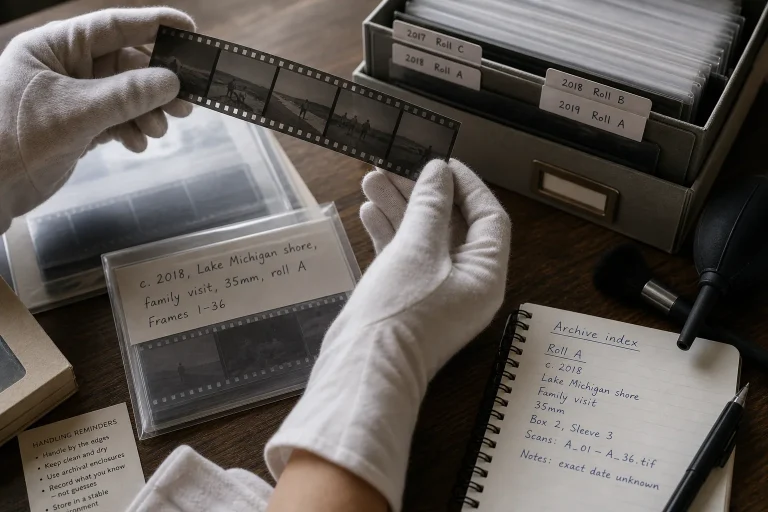
Sleeves, Labels, and the Long Life of a Negative
A clear labeling and storage routine makes film negatives easier to identify, handle, and revisit. Learn…
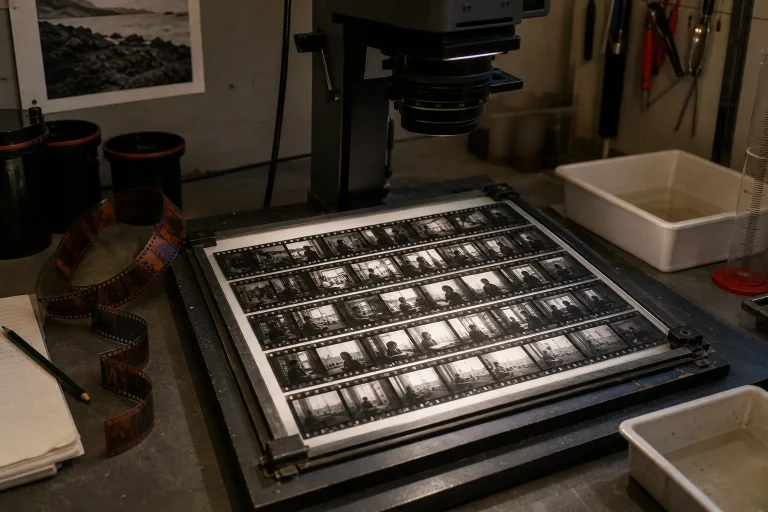
Contact Sheets as a Map of a Roll
A contact sheet turns a strip of negatives into a readable sequence, helping you compare frames,…